
How to Search Kalamazoo County Court Records
The main starting point is the state judiciary case search for the 8th District Court, hosted at micourt.courts.michigan.gov. This portal covers the district-level criminal, civil, and traffic cases filed in Kalamazoo County. It is a login and JavaScript driven system that redirects through an OpenID sign-in and pulls case data live, so it needs an active browser session to return full results. Felony matters that move up to the 9th Circuit Court and probate filings are tracked through separate county channels, which is why the office that holds a file often decides how you search for it.
Before you begin, gather the two identifiers the county asks for most: the case number or a party name. The Record Checks Memorandum from the court is direct about this point, since a public record check may not complete without a case number or the full name of a party. Exact spelling matters, and having an approximate filing date narrows a common name.
The lead-in to the live tool is the Michigan court case search for the 8th District Court, which routes you into the D08 record set for Kalamazoo County.
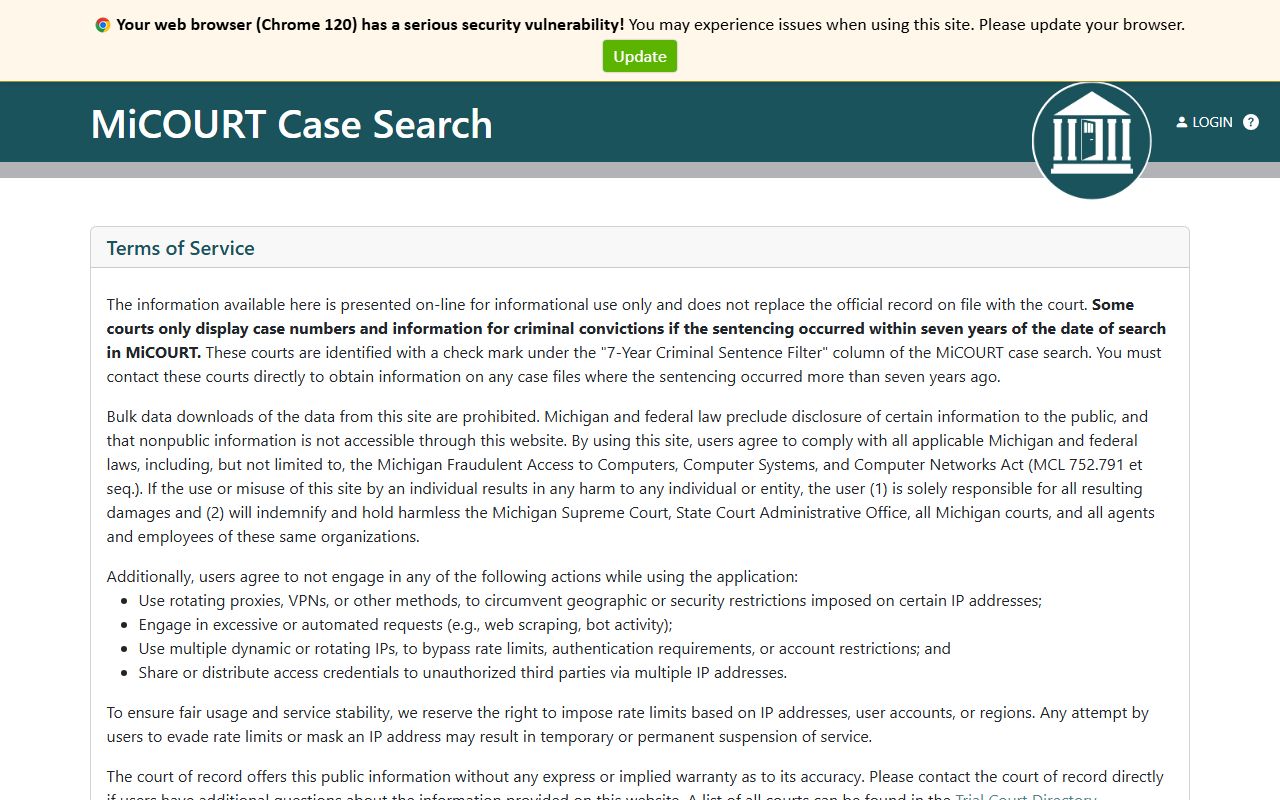
The portal shell loads first, then the case list renders once the session authenticates. Follow these steps to run a clean search.
- Open the 8th District Court case search and allow the page to finish its redirect and sign-in prompt.
- Choose whether you are searching by case number or by party name, using the case number when you have it.
- Enter the full name with correct spelling, or paste the case number exactly as it was assigned.
- Add a case type or approximate filing date to filter out unrelated matches.
- Open the matching case to view its docket entries, hearing dates, and case status.
- If only a citation number appears, note it down and carry it to a clerk copy request for the full file.
Kalamazoo County Court Record Request Fields
When a record is not posted online or you need a certified copy, the county uses the Court Record Copy Request Form. The form asks you to identify yourself, pick how the clerk should reach you, and pin down the exact record by case number or by offense and date. The table below lists the field inventory captured from that form so you can prepare the details before you file. The two identifier options work the same way the online search does: you specify by case number, or by the offense and the date of the offense.
| Field Label | Type | Required | Notes / Format |
|---|---|---|---|
| Date of Request | Text / Date | Yes | The date you submit the form |
| Requested by | Text | Yes | Name of the person asking |
| Preferred method of contact | Radio | Optional | U.S. Mail, Email, or Phone |
| Street Address, City, State, Zip | Text | Optional | Required if you choose mail delivery |
| Email / Phone Number | Text | Optional | Used for the contact method you pick |
| Specify by | Radio | Yes | Case Number, or Offense and Date of Offense |
| Case Number | Text | Conditional | Required if you specify by case number |
| Offense & Date of Offense | Text / Date | Conditional | Required if you specify by offense |
| Party Name(s) / Versus | Text | Optional | One or more parties and the opposing side |
| Nature of Request | Checkbox | Yes | Review record and/or recording |
| Receive Copy by Email | Checkbox | Optional | Opt in for email delivery, add email address |
The county's Record Checks Memorandum sits alongside the form and explains the identifier rule in plain language, so it is worth a look before you submit a broad request. The Kalamazoo County Record Checks Memorandum spells out that specific case or party details are needed for a check to go through.
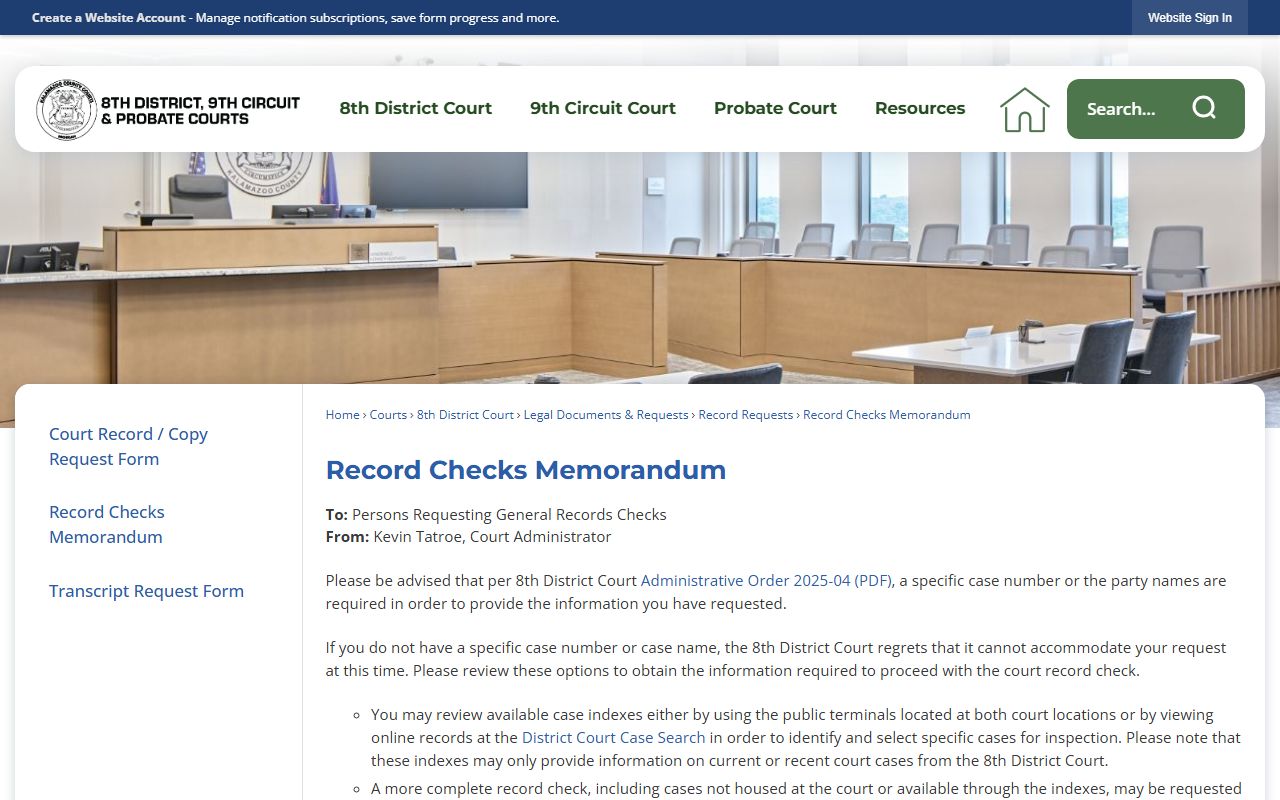
Reading the memo first saves a round trip, because a request with no case number and no full party name is the most common reason a record check stalls at the clerk window.
Types of Kalamazoo County Court Records
The county's trial courts generate several distinct record families, and each one sits with the court that handles that subject. The 8th District Court produces misdemeanor, lower civil, and traffic files, while the 9th Circuit Court holds felony, higher-dollar civil, family, and juvenile matters. Probate Court and the Civil/Probate Division keep estate, guardianship, and mental-health filings.
Knowing which court owns a record type tells you where to search and which request channel to use. The core record types available in Kalamazoo County include the following.
- Criminal records, including charges, arraignment entries, bond amounts, pleas, dispositions, and sentence terms.
- Civil records, covering complaints, docket movement, hearings, and judgment entries at both district and circuit levels.
- Family court records, including domestic relations, custody, protection, and related support proceedings.
- Probate records, such as estates, wills, trusts, guardianships, and conservatorships.
- Traffic records, where citation outcomes split between the court file and the state driving record.
- Juvenile records, which are highly restricted by statute and not part of the open case list.
Full case dockets and hearing history for these matters are covered on the Kalamazoo County court dockets page, which explains how each entry is logged over the life of a case.
What Kalamazoo County Court Records Show
A Kalamazoo County case file is built around a set of core identifiers that appear across criminal, civil, family, and probate matters. These fields let the clerk group every filing under one docket and let the public locate a case without ambiguity. The inventory below maps the common fields to what each one tells you.
| Field | What It Shows |
|---|---|
| Case Number | The unique court identifier that groups every filing and hearing in one docket. |
| Filing Date | The date the case opened and the clock most deadlines run from. |
| Court Code / Division | Which court and division holds the case, such as district, circuit, or probate. |
| Party Names | The plaintiff, defendant, estate, or respondent tied to the matter. |
| Charge Type / Cause of Action | The alleged offense in a criminal file or the legal claim in a civil file. |
| Hearing Assignments | Scheduled sessions, the assigned courtroom, and upcoming dates. |
| Financial Obligations | Bond amounts, fines, costs, and any assessed fees. |
| Disposition | The outcome of the case, such as a plea, judgment, dismissal, or sentence. |
Records also carry event labels that trace a case from start to finish. On the criminal side you will see arraignment, plea, sentencing, probation, bond, and release. Civil files show statement of claim, summary disposition, and final judgment, while probate files list petitions, letters issued, and accountings. A short glossary of the terms that show up most often follows.
- Docket
- The chronological log of every event and filing in a case.
- Disposition
- The statement of how a case ended, from dismissal to sentence.
- Bond
- Money or a security condition set for a defendant's release.
- Motion
- A formal request asking the court for relief or a procedural action.
Public Access Framework for Kalamazoo County Court Records
Court records in Michigan are presumptively open, meaning the public can inspect and copy them unless a specific seal, confidentiality order, or statute closes the file. County offices describe their release practice against the state public records law at MCL 15.231, which sets the baseline expectation for inspecting and requesting public records. The companion exemption section at MCL 15.243 lists the categories that are held back from routine open-records release.
Court files themselves are governed by the Michigan Court Rules rather than by the general records act alone. The access and records provisions in Chapter 8 of the Michigan Court Rules set out how trial courts handle public files and what stays confidential. The state's records-management guidance for trial courts explains retention and public access in practical terms for clerks and the public alike.
The lead-in to that guidance is the Michigan trial court records management page, which frames how courts store and release case files.
The practical county path is straightforward: begin at the clerk or the online case search, use a case number and party details, and fall back to a formal request for older records that are not searchable online. For sealed, juvenile, or expunged material, the clerk or court must weigh statutory eligibility before anything is released.
Note: Public access is the default for Kalamazoo County court records, but the clerk can withhold sealed, juvenile, and confidential files until a court confirms release is allowed.
Sealed and Confidential Kalamazoo County Court Records
Some Kalamazoo County records are closed to the public by statute or by court order. Juvenile files carry the strongest protection, since the confidentiality rules in MCL 712A.28 restrict who may see information about minors. Adoption records and mental-health commitment proceedings are also treated as confidential, and sensitive identifiers like Social Security and financial account numbers are commonly redacted from public extracts.
Sealed and expunged records follow a separate track. Michigan's set-aside statute at MCL 780.621 defines who may petition to seal a criminal record and after what procedural posture, and a granted order controls how visible the file stays afterward. Chapter 8 of the court rules works alongside these statutes to govern how a court closes or reopens access.
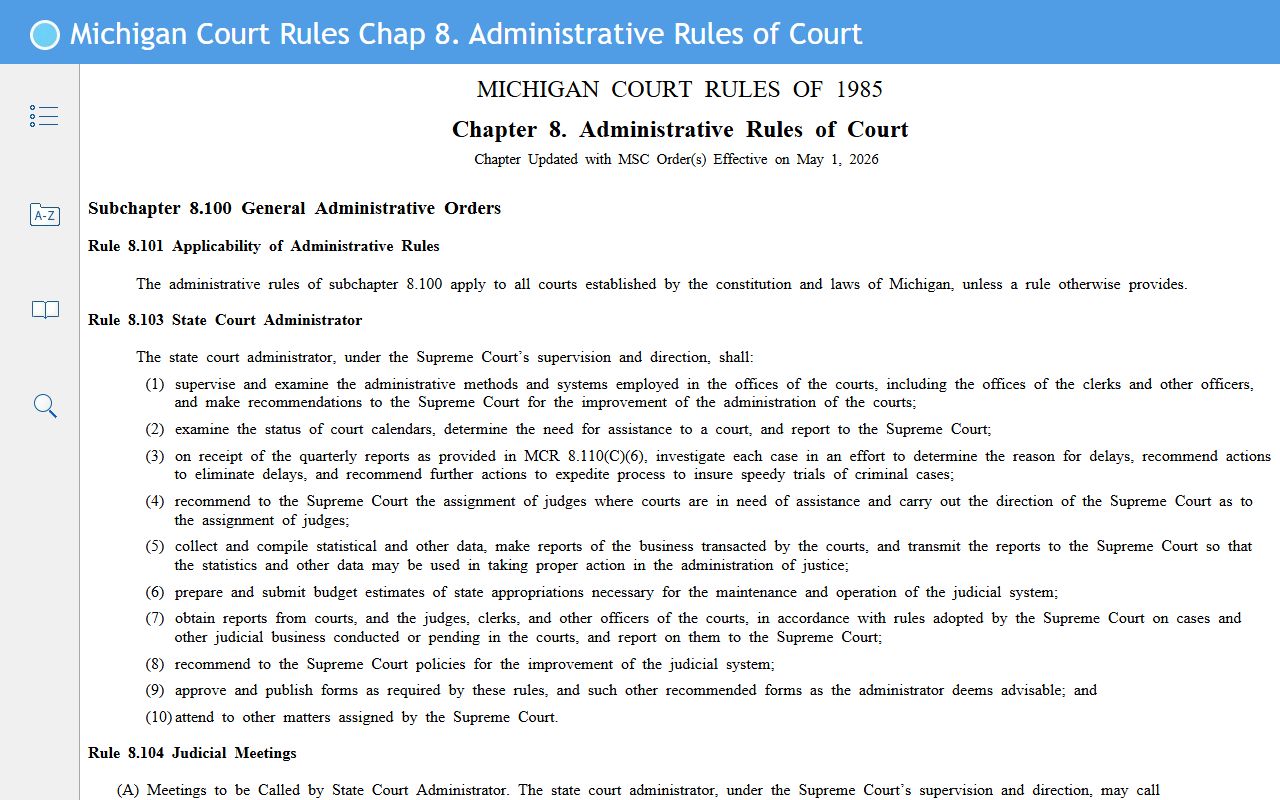
The image above points to the Chapter 8 rule set that clerks apply when a file is restricted. To check the status of a restricted matter, ask the clerk for docket-level status by case number, and understand that a public records request can confirm eligibility only, since final release of a sealed file usually requires a court order. The full criminal case file, including how charges and dispositions are recorded, is detailed on the Kalamazoo County criminal court records page.
Requesting Copies and Transcripts
When you need a physical copy or a verbatim record, the county offers two forms. The Court Record Copy Request Form delivers a review of the record or a copy of a recording, with a processing window of about five to seven days. The Transcript Request Form produces the word-for-word account of a hearing, conference, or trial event, and it is the document you need when a matter is headed to appeal.
Start a copy order at the Kalamazoo County Court Record Copy Request Form, which walks you through the identifier and delivery fields.
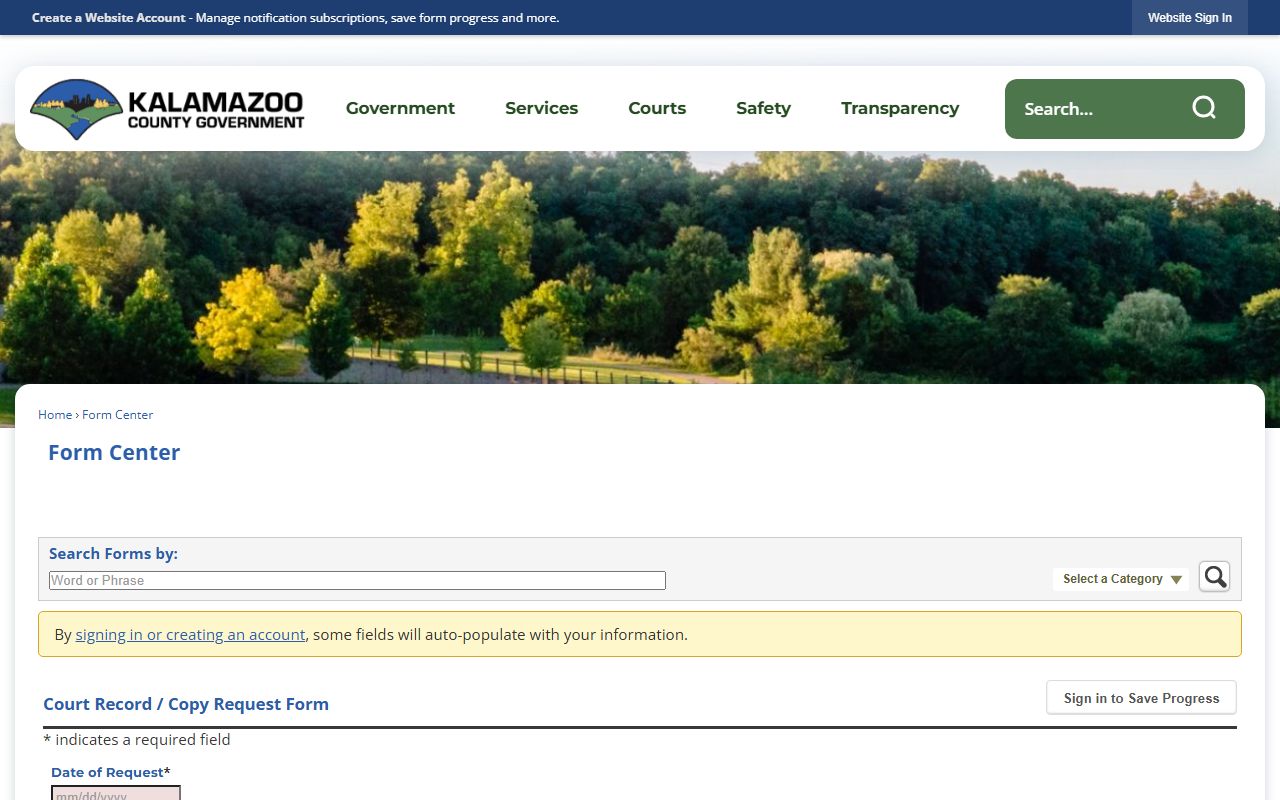
That form is the free records-request path for reviewing a file or ordering a recording, and it asks you to specify the case by number or by offense so staff can pull the right record.
For a transcript, the county uses a separate form that asks for the date of the court event, the case number, the type of event, the parties, and the magistrate or judge who heard the matter. It also asks whether the transcript is needed for an appeal, which affects how the request is handled. Open the Kalamazoo County Transcript Request Form to begin.
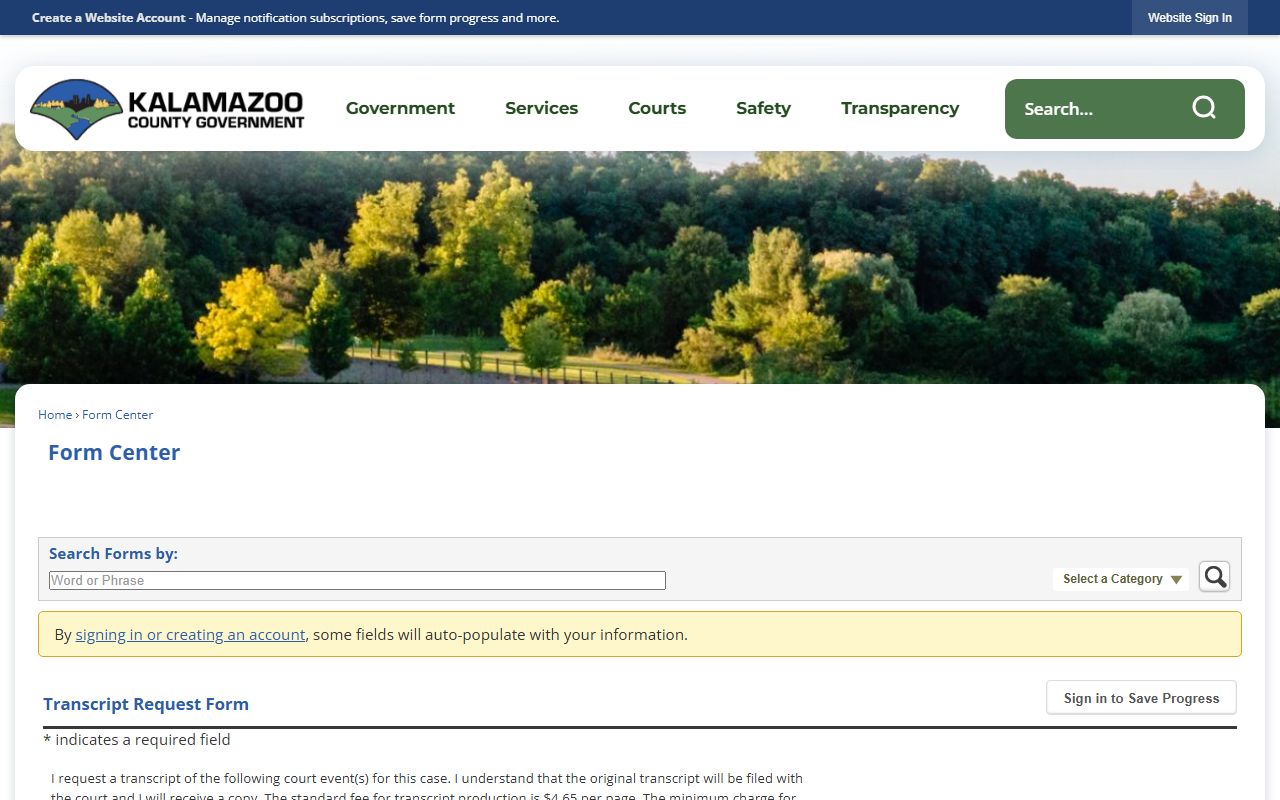
The transcript form is a request path rather than an instant download, so plan for preparation time. A no-cost online search and an in-person review are the ways to look at a record for free, while certified copies and transcripts carry the fees set in the clerk fee schedule.
In-Person Court Record Requests
You can also handle a record request in person at the clerk window. The court's records intake sits at the Judge Charles A. Pratt Justice Center at 330 Eleanor Street, where the 8th District Court moved in December 2023. Bring the case number or a full party name, a photo ID, and the fee for any certified copy you want issued. Staff can point you to a public terminal for the online case search or take your completed copy or transcript form at the counter.
Beyond the clerk window and the two request forms, the county's formal records path runs through its FOIA procedure, which is the route for broader requests that a routine case check cannot cover. For historical files that predate the online index, the clerk retrieves records from physical archives, so allow extra time. The Record Requests hub gathers these channels in one place.
Clerk of Court, Kalamazoo County
330 Eleanor St.
Kalamazoo, MI 49007
269-384-8171
Mon-Fri 8:00 AM-4:30 PM
Whichever channel you use, the same rule holds: a case number or a full party name is what turns a request into a record. Start online, keep any citation number you find, and carry it to the clerk or a request form to reach the complete file.