
How to Search Kalamazoo County Traffic Court Records
Most traffic cases in the county are searched through the state judiciary case-lookup tool for the 8th District Court. The Michigan district court case search lets you pull open and closed matters by case number or party name. It shows citations that are still pending as well as tickets that were paid, dismissed, or resolved after a hearing.
Have your ticket in hand before you start. The identifiers that make a search work are the case number, the party name spelled exactly, the citation number printed on the ticket, and the offense date. A name-only search can return several people, so a case number always narrows the result faster.
- Open the district court case search and select the 8th District Court (court code D08).
- Enter the case number if you have it, or type the driver's full legal name.
- Add the offense date or case type to filter a common name down to one match.
- Open the case to review the charge, the hearing date, the plea, and the disposition.
- From there you can pay, set a hearing, or ask the clerk for a certified copy.
Note: if a search returns only a citation number and no full case, capture that number and use it on the district court record copy request form.
Which Court Handles Traffic Cases in Kalamazoo County
Traffic in Kalamazoo County runs through the 8th District Court Traffic Division. The district court handles civil infractions, misdemeanor traffic offenses, and the citations that local, county, and state officers write across the county. The Traffic Division is the office that processes payments, schedules informal and formal hearings, and records how each ticket is resolved.
The court's records and counter functions sit inside the Judge Charles A. Pratt Justice Center, where the district court moved in December 2023. You can read the division's own guidance on the county Traffic Division page, which lays out payment and hearing options for a citation.
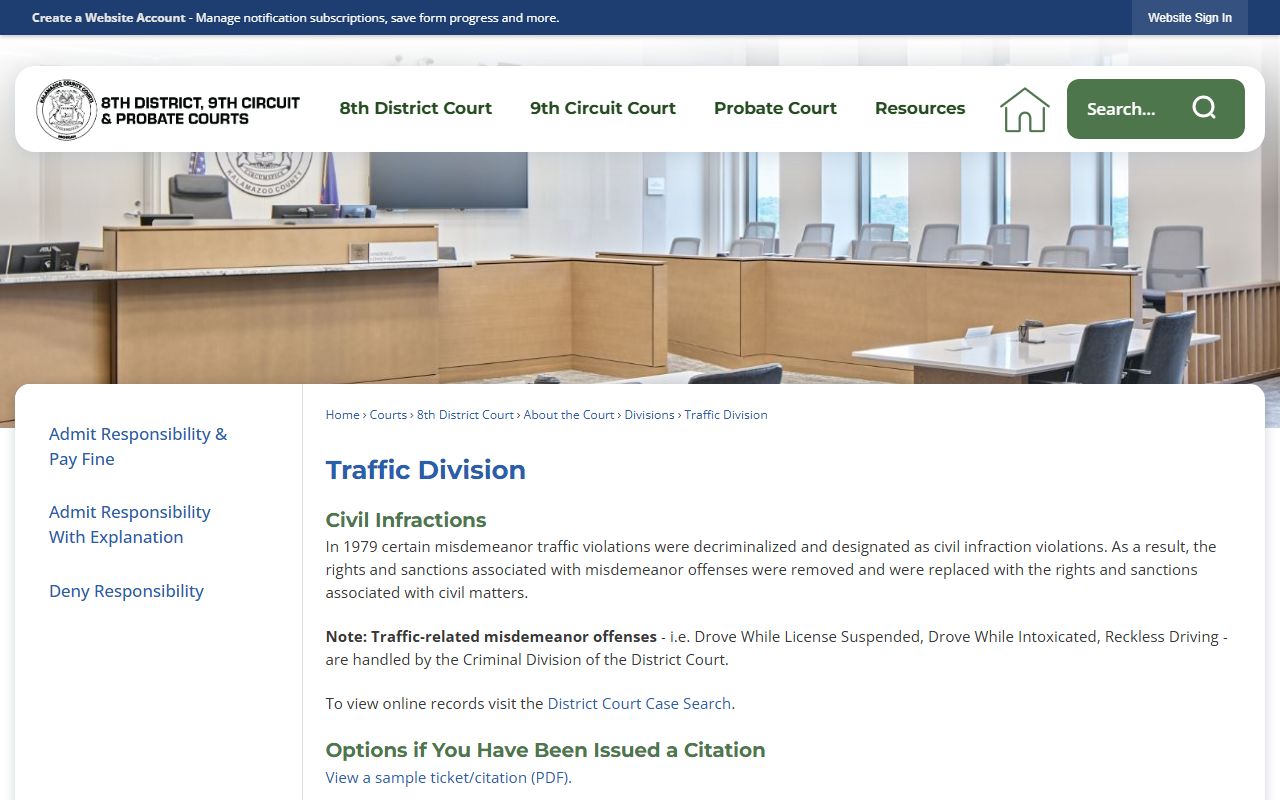
That page is the starting point for anyone deciding whether to admit, explain, or contest a ticket before the deadline printed on it passes.
8th District Court, Traffic Division
Judge Charles A. Pratt Justice Center
330 Eleanor St.
Kalamazoo, MI 49007
269-384-8171
Mon–Fri 8:00 AM–4:30 PM
Types of Traffic Cases on Record
Not every ticket carries the same weight, and the court file reflects that. Some tickets are civil infractions with a fine and points, while others are misdemeanor offenses that can bring jail exposure and a formal criminal case. The record shows which track a citation followed.
- Moving civil infractions - speeding, disobeying a signal, and improper lane use, resolved by fine and points.
- Non-moving and equipment - expired plates, no proof of insurance, and equipment defects.
- Misdemeanor traffic - driving on a suspended license or reckless driving, which open a criminal case.
- Commercial vehicle - citations against drivers holding a commercial license, which follow stricter federal reporting.
- Serious offenses - operating while intoxicated, which route out of the traffic track into criminal proceedings.
What Kalamazoo County Traffic Court Records Show
A traffic case file is a running log of the citation from the day it was written to the day it closed. It ties the charge to a driver, a court date, and a financial outcome. The fields below are the ones drivers most often need when they pull a record.
| Field | What It Shows |
|---|---|
| Citation Number | The ticket number the officer assigned at the stop. |
| Charge and Statute | The Michigan Vehicle Code section the driver is cited under. |
| Court and Division | The 8th District Court and the hearing assignment. |
| Hearing Date | The scheduled appearance, informal hearing, or formal hearing date. |
| Plea or Response | Admit, admit with explanation, or deny responsibility. |
| Disposition | The outcome, such as responsible, dismissed, or reduced. |
| Fine and Costs | The fine, state costs, and any surcharges owed. |
| Points | The points the court reports to the state driving record. |
The court file does not carry your full license status or suspension history. That data lives on the state driving record, a separate file explained further down.
How to Pay or Contest a Kalamazoo County Traffic Ticket
A civil infraction gives a driver three basic responses, and the ticket sets a deadline to choose one. You can admit responsibility and pay, admit with an explanation, or deny responsibility and ask for a hearing. Each choice sends the case down a different path.
Denying responsibility opens the county's Deny Responsibility workflow. That path leads to either an informal hearing, held before a magistrate with the citing officer present and no attorneys, or a formal hearing, where attorneys may appear and the rules are stricter. Payment can be made online, by mail, or at the court counter before the response date.
- Admit responsibility. Pay the full fine and costs by the deadline; the citation closes and points are reported.
- Admit with explanation. Submit your side in writing or in person; the magistrate may lower the fine but the infraction still stands.
- Deny responsibility. Request a hearing through the Deny Responsibility page instead of paying.
- Informal hearing. Appear before a magistrate with the officer; no lawyers take part.
- Formal hearing. Ask for a formal hearing if you want an attorney to present the case.
You can read the district court's role in these hearings on the county 8th District Court page. It outlines how the traffic docket fits into the broader district court operation.
Reviewing that page before a hearing date helps drivers arrive at the right counter with the right paperwork.
Searching by Citation Number vs by Name
The county did not expose a standalone public citation-search portal in its online tools. Traffic lookups run through the same 8th District Court case search used for other cases, so the search fields are the general case identifiers rather than a dedicated ticket box. The citation number is still useful, but you often use it on the clerk's copy request form rather than in a live search.
| Search Field | Type | Required | Notes / Format |
|---|---|---|---|
| Case Number | Text | Conditional | Preferred identifier when known. |
| Party Name | Text | Conditional | Full legal name, exact spelling. |
| Citation Number | Text | Optional | Printed on the ticket; capture it for a clerk copy request. |
| Offense and Date of Offense | Text / Date | Conditional | Alternate to the case number on the copy request form. |
| Court / Division | Filter | Optional | Select the 8th District Court (court code D08). |
A case number is exact, so it beats a name search when a driver shares a common name. A name search casts a wider net and is the fallback when the ticket is lost. If neither returns the file, the clerk's record copy request form accepts the citation number or the offense and date instead.
Public Access Laws for Traffic Court Records
Traffic court files are court records, and Michigan treats court records as presumptively open unless a specific rule or statute closes them. The Michigan court rules on records access, along with the state's public records law, set the baseline for what a clerk must release and what stays exempt.
Key Statutes:
Michigan Compiled Laws § 15.231 - the Freedom of Information Act, requiring public bodies to release non-exempt records on request.
Michigan Compiled Laws § 15.243 - lists the categories a public body may withhold from routine release.
For older tickets that no longer appear in the online search, the fallback is a formal request. Drivers can order a copy through the district court clerk or the county records-request channel, using the case number or offense details to locate the file.
Court Traffic Records vs State Driver Records
This is the split that confuses most drivers. The court traffic record is the case file the 8th District Court keeps for one citation. The state driver record is a running license history kept by the Michigan Secretary of State. A dismissed ticket in the court file and a clean line on the driving record are not the same document, and you fix errors in each place differently.
| Court Traffic Record | State Driver Record | |
|---|---|---|
| Record source | 8th District Court, Kalamazoo County | Michigan Secretary of State |
| What is in it | Citation, hearing events, plea, fine, and disposition | Convictions, points, license status, and suspensions |
| Where to access | District court case search or the clerk's copy request | Secretary of State driving record service |
| How to correct errors | Ask the court clerk to review the case entry | Contact the Secretary of State to dispute the abstract |
You can order your license history from the Michigan driving record service. It reflects convictions the court reported, so a fix in the court file should flow through to the state record once the court transmits the correction.
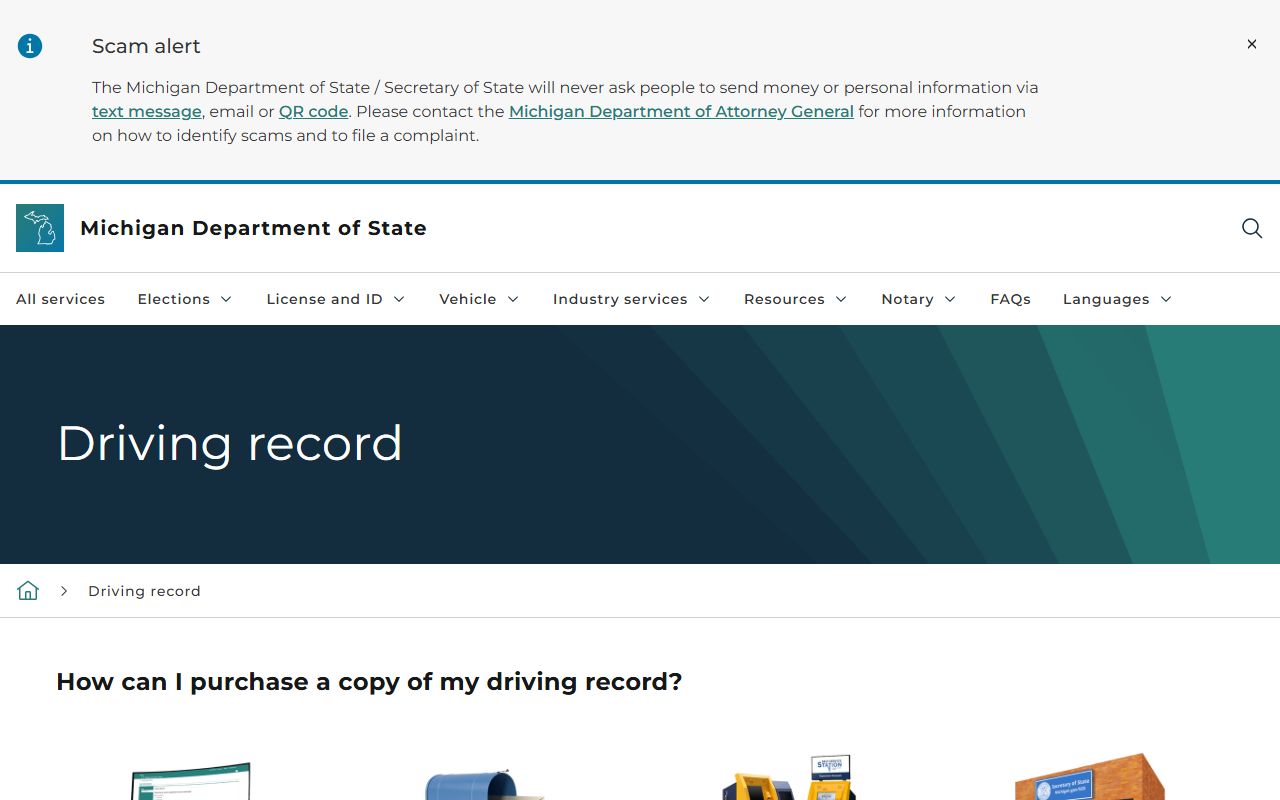
Employers, insurers, and license reviews look at the state record, so checking both after a case closes is worth the extra step.
DUI and OWI Cases in Kalamazoo County
Operating while intoxicated is not a civil infraction. In Michigan it is a criminal charge, so an OWI or drunk-driving case does not stay on the traffic docket. It opens a criminal file in the district court and can move to the 9th Circuit Court for higher-level proceedings. The plea options and record fields look nothing like a routine ticket.
Because these cases follow the criminal track, their charges, pleas, and sentences appear in the Kalamazoo County criminal court records rather than in the traffic file. That is where arraignment, bond, and disposition details for a drunk-driving case are recorded.
CDL and Commercial Driver Records
Commercial drivers face rules a regular license holder does not. A driver who holds a commercial license is judged by a stricter standard even in a personal vehicle, and many violations cannot be masked or deferred the way they might be for other drivers. Federal reporting rules push commercial convictions onto the driving record quickly.
A citation that seems minor can threaten a livelihood, so commercial drivers should confirm how the court coded the disposition. The court file shows the charge and outcome; the state driver record shows how that outcome hits the commercial endorsement. Checking both matters even more here than for a standard ticket.
The Michigan Department of State services page is the route to the license side of a commercial record and its endorsements.
Deferred Options and Defensive Driving
Drivers sometimes ask whether a class or an agreement can keep a ticket off the record. In Michigan the practical tool is the magistrate's discretion at an informal hearing. An admission with an explanation can lead to a lower fine or, in some cases, a reduced charge that carries fewer points, though the decision rests with the court.
There is no guaranteed defensive-driving dismissal for every citation. The safest path is to raise the request directly with the Traffic Division when you set a hearing, and to confirm in writing how any agreement will be entered on the file. What matters for the record is the final disposition the court enters, not the informal conversation.
Missed Hearings and Warrant Risk
Ignoring a ticket is the costliest choice. Missing a scheduled hearing or a payment deadline can lead the court to enter a default, add costs, and report a failure to appear that puts the driver's license at risk. In a misdemeanor traffic case, a missed date can trigger a bench warrant.
Important: If you miss a traffic hearing on a misdemeanor charge, the court can issue a bench warrant, so contact the 8th District Court clerk before your date passes to reschedule and avoid it.
If a warrant may already exist, the fastest fix is to call the district court clerk and ask how to clear the missed date. Handling it early usually costs far less than being picked up on the warrant later.
Sealing, Expunging, and Record Copy Fees
Civil infractions are not criminal convictions, so most routine tickets cannot be set aside or expunged the way a misdemeanor can. Certain misdemeanor traffic offenses may qualify for a set-aside under Michigan's expungement statute, which sets who is eligible and after how long. You can read the baseline rule at Michigan Compiled Laws § 780.621.
When you need a paper copy of a traffic case, the district court clerk provides it through a records request. Certified copies carry the county's standard certified-copy fee, and these files can be ordered through the same channels as other Kalamazoo County court records. The state driving record is a separate order with its own fee set by the Secretary of State.
| Item | Amount |
|---|---|
| Court record copy request (review form) | No fee; 5 to 7 business days |
| Certified copy, first copy | $20 |
| Certified copy, each additional copy | $7 |
| Michigan driving record (Secretary of State) | Fee set by the Secretary of State |
Note: uncertified copies pulled from the online search are fine for personal reference, but a court proceeding usually requires a certified copy from the clerk.