
Criminal Court Records in Kalamazoo County
A criminal court record is the case file that a court clerk opens the moment charges are filed against a defendant. It is not the arrest report and not the jail booking sheet. It is the running court file that holds the charging document, the arraignment entry, every motion, each hearing date, the plea or verdict, and the final sentence. In Kalamazoo County the clerk staff at the criminal divisions keep these files as cases move forward. For a closer look at the charges themselves, the Kalamazoo County court charge records page breaks down how a prosecutor files and later changes a count.
Two trial courts hear criminal matters in the county. The 8th District Court handles misdemeanors, sets bond at first appearance, and runs the preliminary exam stage for felonies. The 9th Circuit Court handles felony trials, sentencing on serious counts, and criminal appeals. Because a felony starts in district court and then binds over to circuit court, one criminal event can leave a trail in two separate case files. Knowing which court holds the record you want saves time before any search begins.
The county criminal division page shows how charging, probation, and disposition duties fit together across these courts. That workflow is described on the county Criminal Division page.
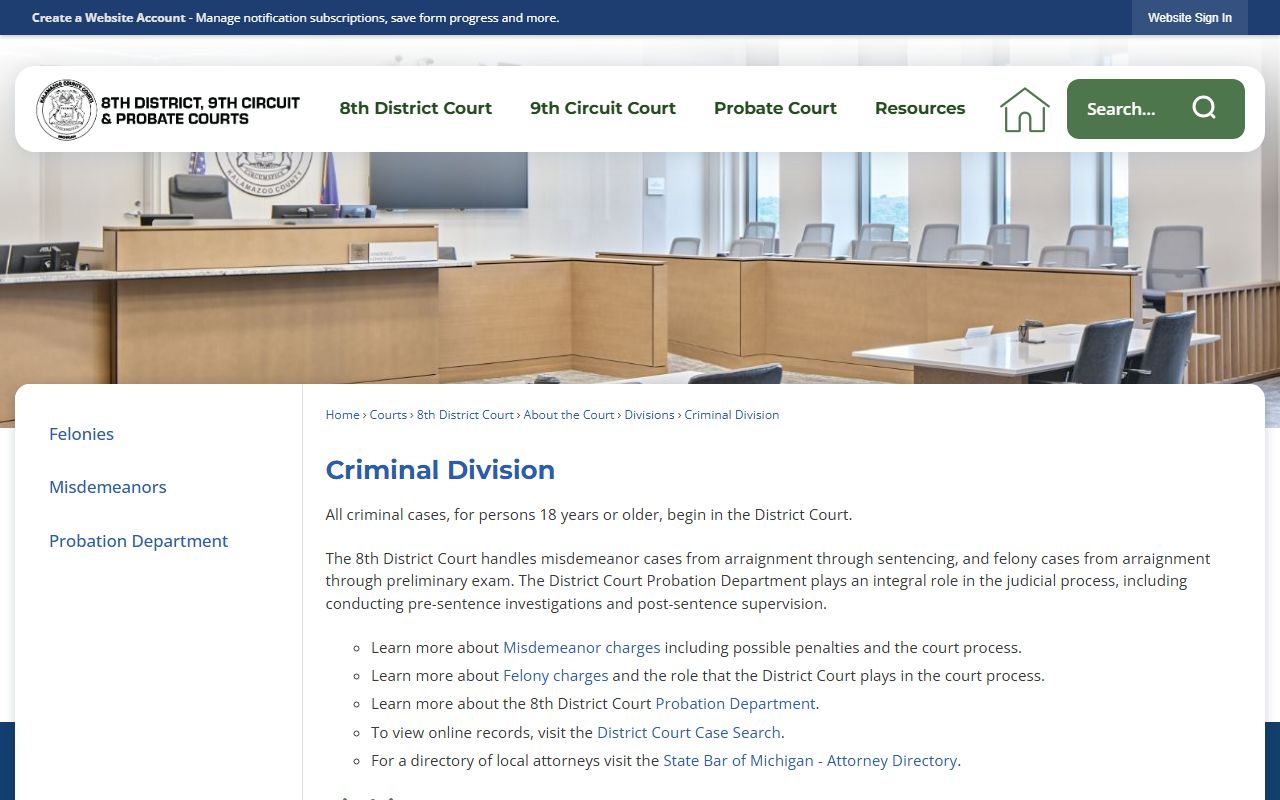
The division outline confirms that district court staff manage arraignment-to-appeal steps while probation tracks supervision, so a single criminal record can gather entries from several offices at once.
How to Search Kalamazoo County Criminal Court Records
Most current criminal cases can be found through the statewide court case search, which includes the 8th District Court under its D08 code. A defendant name or a case number opens the fastest path. The portal shows the docket, the charge list, and the case status once the file loads.
- Open the Michigan court case search for the 8th District Court and accept any access terms shown on the entry screen.
- Search by the defendant name or, if you have it, the exact case number, since a case number returns the cleanest match.
- Narrow the results by court level, case type, and filing date to separate criminal counts from civil or traffic entries.
- Open the case to read the docket, the recorded plea, and the disposition line that closes each charge.
- Request a certified copy from the clerk when you need a stamped record for a legal or official purpose.
When a case predates the online index or does not appear in the portal, the fallback is a records request through the district court clerk. Staff need a case number or a party name plus an offense date to pull an older file. For a broader look at every record channel the courts run, the Kalamazoo County court records page maps the clerk request forms and public terminals.
Stages of a Criminal Case
A criminal case moves through a fixed set of steps, and each step drops a new entry into the court record. Reading the file in order shows exactly where a case stands. A misdemeanor can run its whole course in the 8th District Court. A felony starts there, clears a preliminary exam, and then binds over to the 9th Circuit Court for the trial and sentencing phase.
Case flow: Charges Filed › Arraignment › Pretrial / Motions › Plea or Trial › Disposition › Sentencing. For felonies the file also carries a bindover step, where the 8th District Court sends the case up to the 9th Circuit Court after the exam.
| Stage | What Happens |
|---|---|
| Arraignment | The court reads the charges, sets bond, and records the first plea. This entry starts the case file. |
| Pretrial / Motions | Lawyers file motions, exchange discovery, and set hearing dates. Felonies clear a preliminary exam and bind over to circuit court here. |
| Plea or Trial | The defendant enters a final plea or the case goes to a bench or jury trial that reaches a verdict. |
| Sentencing | The judge imposes a sentence and the clerk records the terms, closing the active phase of the file. |
The county prosecutor drives the charging and appeal side of this flow. Prosecuting Attorney Jeffrey S. Getting runs an office split into Circuit Court, District Court, and Family Court divisions, each matched to a court level. That structure is shown on the Prosecuting Attorney office page.
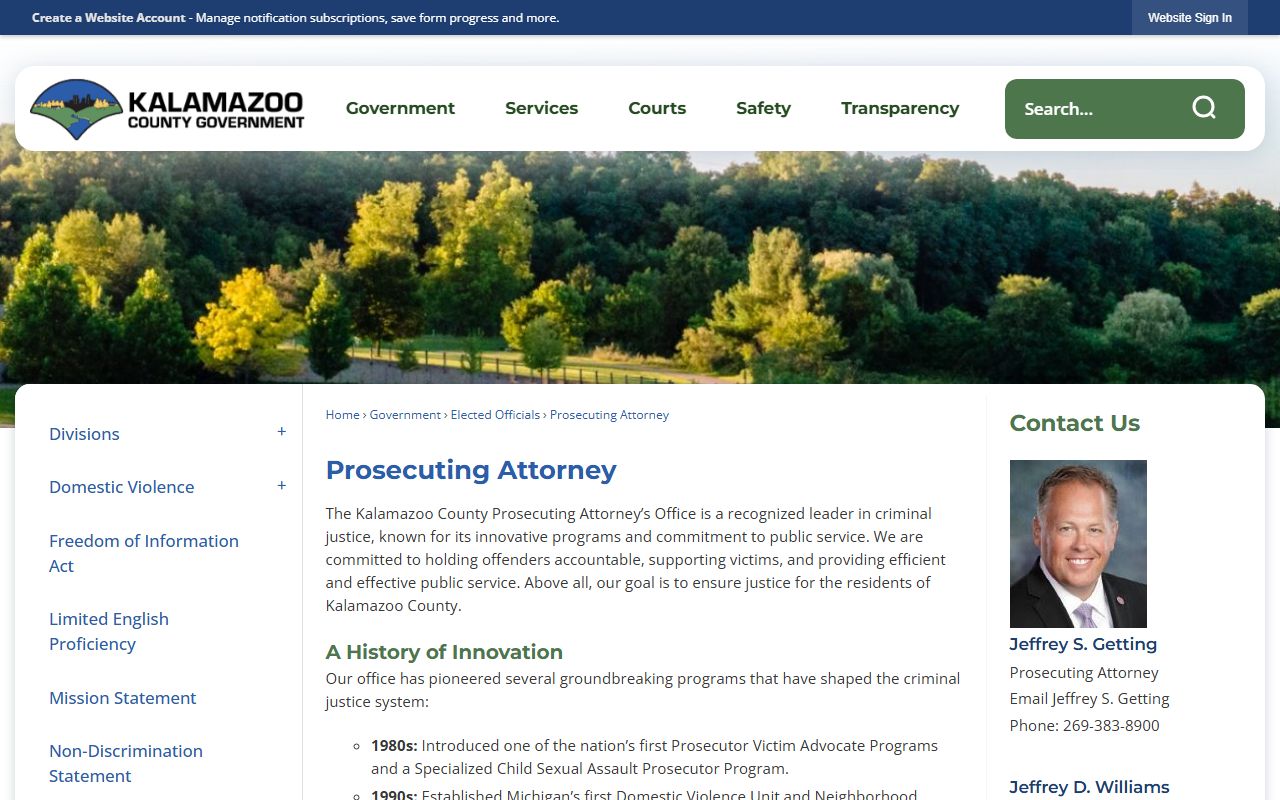
Because the prosecutor files and can later amend the counts, the charge line in a criminal record often shifts between arraignment and disposition as the case is negotiated.
On the defense side, a person who cannot afford a lawyer is screened for a court-appointed attorney at or near arraignment. Kalamazoo Defender, a contracted nonprofit office, handles much of the county's indigent criminal defense. Assignment depends on the qualifying review the court runs at that first appearance.
What a Kalamazoo County Criminal Court Record Shows
A criminal case file follows a standard layout across the county courts. The header block carries the identifiers, and the body carries the event history. Reading the fields in order tells you who was charged, with what, and how the case ended. The list below reflects the core fields a Kalamazoo County criminal filing tends to show.
| Field | What It Shows |
|---|---|
| Case Number | The unique court ID that groups every docket entry for one criminal matter. |
| Defendant | The name of the person charged, along with the court division handling the file. |
| Charges | Each count as filed, with the statute cited and the severity level, from misdemeanor to felony. |
| Plea | The defendant response to each charge, such as guilty, not guilty, or no contest. |
| Disposition | The outcome line that closes a charge: convicted, dismissed, acquitted, or reduced. |
| Sentence | The punishment and supervision terms, including jail, probation, fines, and costs. |
Alongside these fields the docket lists every motion filed, each hearing scheduled, any bond change, and the assigned judge or magistrate. A pre-sentence entry, a probation term, or a later revocation can all appear once sentencing lands. Financial obligations such as fines, court costs, and restitution show as separate line items with running balances.
Charges vs. Convictions
Being charged is not the same as being convicted, and a criminal court record makes that gap plain. A charge is only an accusation the prosecutor files. A conviction is the finding a court reaches after a plea or a trial. Many files show counts that were dropped, dismissed, reduced, or that ended in acquittal, and none of those are convictions. Reading the disposition line for each count, not just the charge line, is the only reliable way to tell what actually stuck.
| Charge | Conviction | |
|---|---|---|
| Stage | Accusation | Verdict or plea |
| Who Decides | Prosecuting attorney | Judge or jury |
| Burden of Proof | Probable cause | Beyond reasonable doubt |
| Can Change | Amended, reduced, or dropped | Appealed or set aside later |
| Public Record | Yes | Yes |
Note: A dismissed or acquitted charge stays visible in the public case file unless a court later seals or sets it aside under state law.
Reading Dispositions and Sentences
The disposition is the single most useful line in a criminal record because it states the outcome. Common entries include guilty, not guilty, dismissed, and no contest, sometimes shown as nolo. A deferred entry means the court held the case open under conditions, and the final result depends on whether those conditions were met. Each count in a multi-charge case carries its own disposition, so one file can hold a conviction on one count and a dismissal on another.
The sentence follows the disposition and lists the terms the judge imposed. In a Kalamazoo County file the sentence block can name jail time, probation, fines, court costs, restitution, and any conditions such as treatment or no-contact orders. A later probation revocation or an amended judgment appears as its own docket entry with a fresh date, so the record shows changes over time rather than replacing the original terms.
Specialty and Problem-Solving Courts
Some criminal cases in Kalamazoo County route into a specialty court instead of the standard track. These problem-solving courts pair close supervision with treatment and regular status reviews. They usually require a guilty plea to enter, and a participant who misses obligations can be moved back into normal criminal exposure. The county runs several, including an Adult Men's Drug Treatment Court, a Women's Drug Treatment Court, and a Swift and Sure Sanctions program, each managed by an assigned judge.
The full slate of programs and their case managers is listed on the county Problem-Solving Courts page.
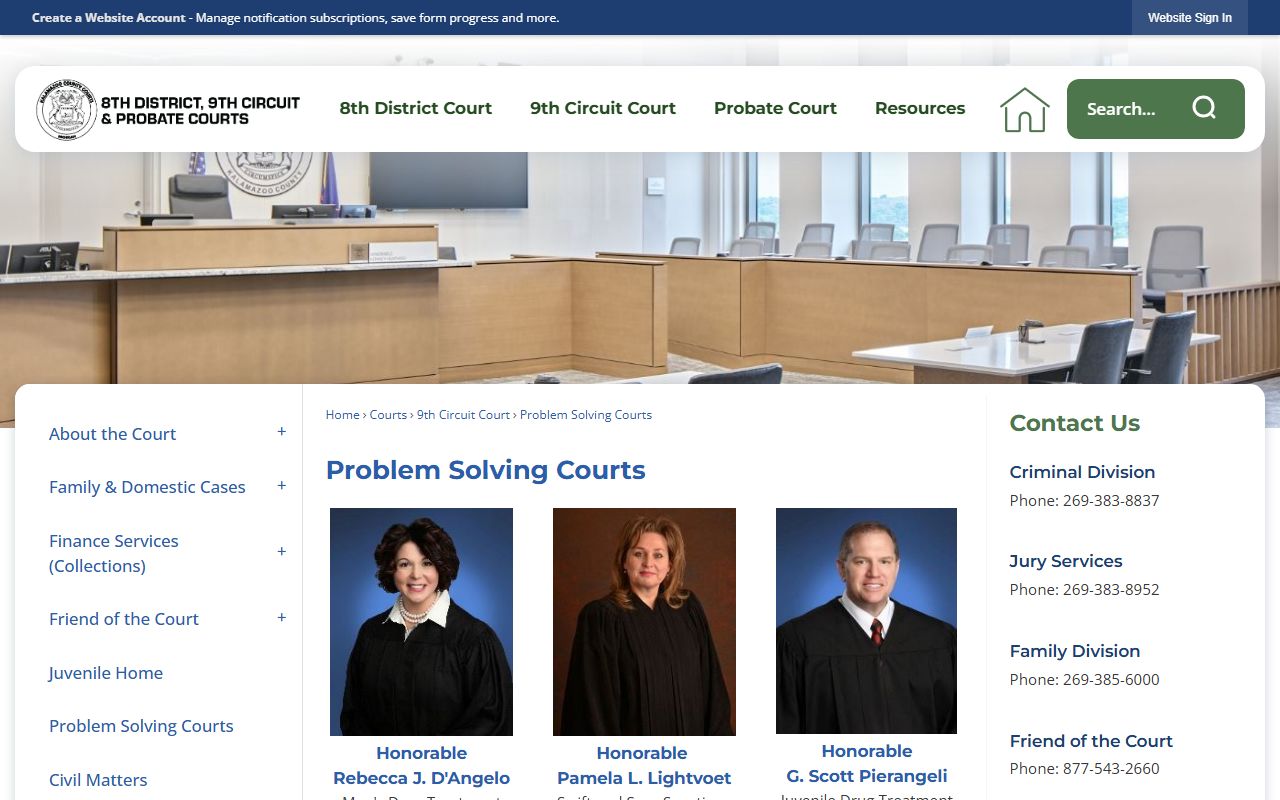
Because entry runs through a guilty plea, a case handled in one of these tracks still leaves a conviction-stage record even when the sentence centers on treatment rather than jail.
A hub page gathers the specialty court options in one place, including drug treatment, family treatment, and the swift and sure model. That directory sits on the county Specialty Courts page.
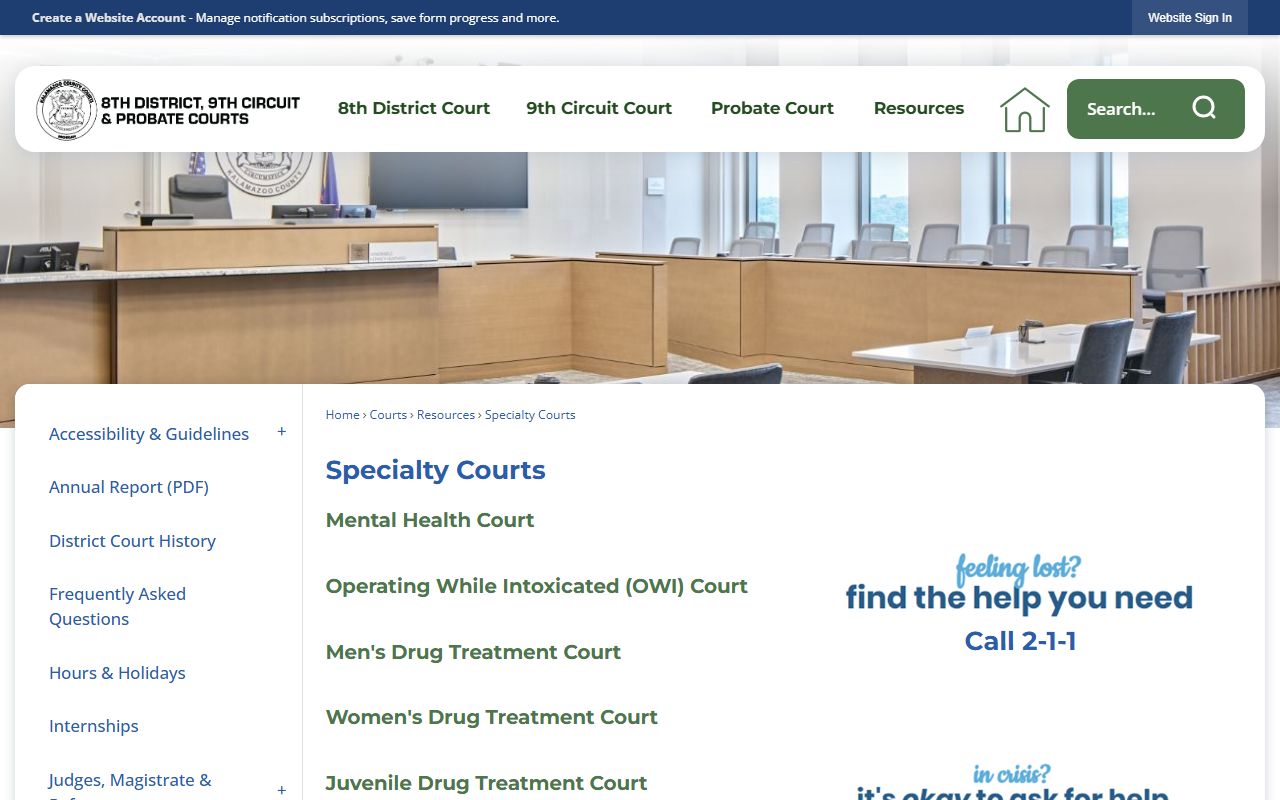
The hub shows that a case assigned to a specialty docket is still tracked as a criminal matter, so its status and outcome remain part of the searchable court record.
Sealed vs. Expunged Records
Michigan treats sealing and setting aside a record as court-ordered actions, not automatic outcomes. A sealed record is hidden from routine public view but still exists in limited channels. A set-aside, which Michigan uses where other states say expunged, treats the conviction as though it never happened for most purposes. Both require a petition and a court order, and eligibility turns on the type of offense and how much time has passed since the case closed.
| Sealed | Expunged / Set Aside | |
|---|---|---|
| Visibility | Hidden from public view | Treated as if it never occurred |
| Law Enforcement | Limited access remains | Very limited access remains |
| How It Happens | Court order on petition | Court order on petition |
| Eligibility | Set by offense type and case posture | Set by offense type and waiting period under MCL 780.621 |
The set-aside framework begins with the main statute, which defines who may seek relief and after what procedural posture. That landing point is the Michigan set-aside statute, MCL 780.621.
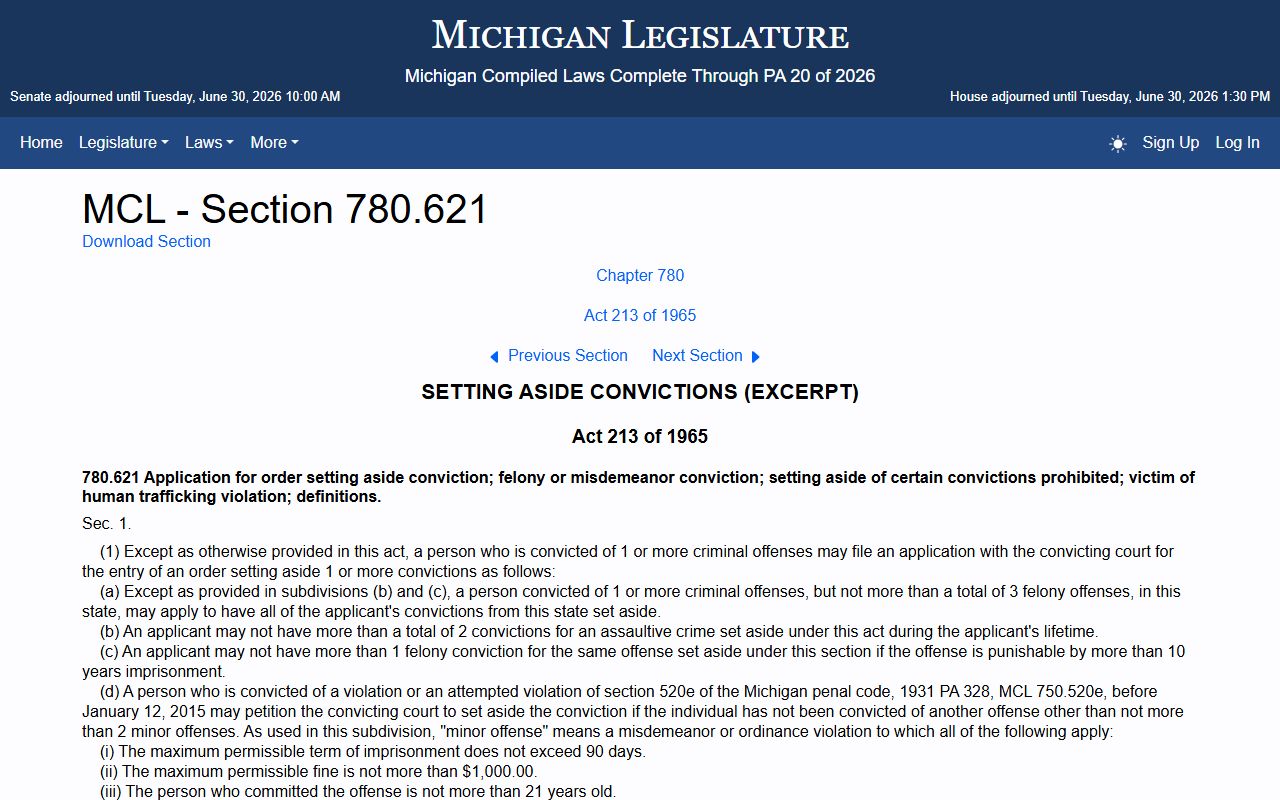
The statute sets the base rules, while linked subsections carry the added eligibility limits and the effects of an order once it is granted.
Related subsections expand on which convictions qualify and what a set-aside does to a record once entered. One of those follow-on provisions is Michigan MCL 780.621a, with parallel language in 621b and 621c.
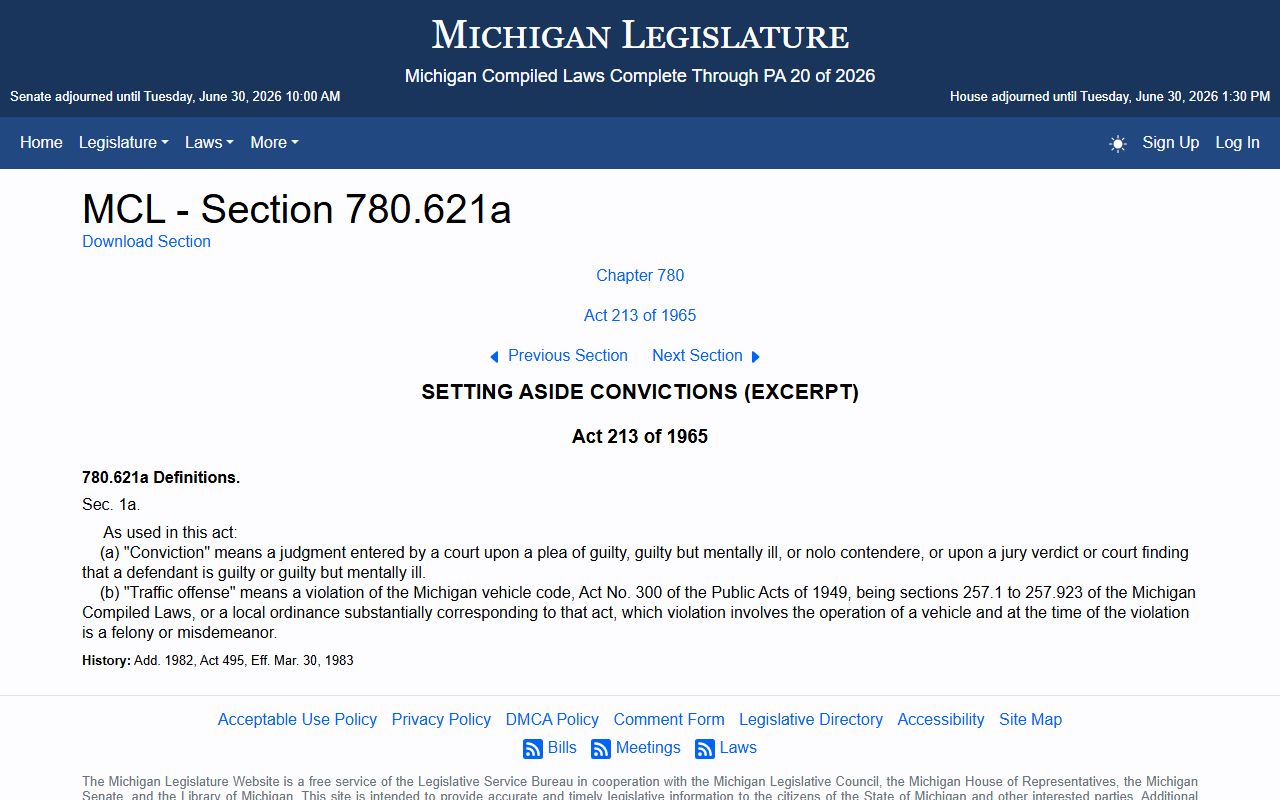
Because these provisions layer, a clerk or the court must confirm statutory eligibility before any conviction is hidden or cleared from the public file.
Public Access to Criminal Court Records
Criminal court files in Kalamazoo County are presumed open. Michigan court rules treat case records as public unless a specific seal, a confidentiality order, or a statute closes them. The state open-records law backs that presumption for records held by public offices, while a companion section lists the categories that stay exempt. Together they set the frame a clerk uses when deciding what to release.
Key Statutes:
Michigan MCL 15.231 - Establishes the public right to inspect and request records held by state and local offices.
Michigan MCL 15.243 - Lists the categories that public bodies may withhold from routine release.
The court system spells out its own record handling in the state trial court rules. The public-access framework for case files sits in the Michigan courts records management guidance, which local clerks follow when they process a criminal file request.
Background Check Considerations
A casual name search of criminal court records is not the same as a formal background check. A regulated background check runs under the federal Fair Credit Reporting Act and follows strict rules on accuracy, notice, and use. A quick look at a public case file carries none of those protections and can miss sealed or set-aside outcomes. For any decision tied to hiring, housing, or credit, an FCRA-compliant report from a licensed provider is the correct tool.
Important: This site is not a consumer reporting agency under the FCRA, and its content may not be used for employment, tenant, credit, or other regulated screening decisions.
Restricted Criminal Court Records in Kalamazoo County
Not every criminal matter is open to the public. Juvenile cases carry the strictest limits, since state law shields records that involve minors from routine disclosure. Sealed files, set-aside convictions, and some ongoing matters are also held back until a court clears their release. Personal identifiers such as Social Security numbers and financial account data are commonly redacted even from files that are otherwise public.
Juvenile confidentiality rests on its own statute, which limits who may view and use records tied to a minor. That base rule is Michigan MCL 712A.28, and the courts apply it before releasing any juvenile file.
Note: When a record is sealed, juvenile, or under a court hold, the clerk can confirm eligibility for release but the final decision rests with a judge.